When we mention the existence in English, we would say there is bla bla or there are bla bla. However, there are two verbs in Japanese, ある(aru) and いる(iru). Today, I’m going to teach you the difference between ある and いる. Contents あるいるliving and not livingconclusionある ある is a group 1 verb. What’s a group…
Read MoreThere are three groups for Japanese verb conjugation. In this article, I will teach you plain form and polite form past tense in each groups. If you don’t know three groups, please read this article first. Japanese verb conjugation rule with chart Contents Polite formGroup 1Group 2Group 3 Polite form chartPlain formGroup 1Group 2Group 3…
Read MoreHow can you add information to a noun and explain the noun more specifically. When you read this article, you will learn how to say that this is my pen or this is a key to a car in Japanese. Contents how to use のhow to ask and answerconclusionhow to use の の describes next…
Read MoreHow can we make negative sentences in Japanese? In this article, I will teach you how to create negative sentences in Japanese. Contents Nounナ adjectiveイadjectiveverbGroup1group2group3conclusionNoun There are two ways to make negative sentences for nouns, which are ではありません or ではないです。 Noun+ではありません/ではないです (ex)A: あなたはアメリカじんですか。 B: いいえ、アメリカじんじゃ(では)ありません。 or いいえ、あめりかじんじゃ(では)ないです。 Let’s learn more. What’s the difference between じゃない…
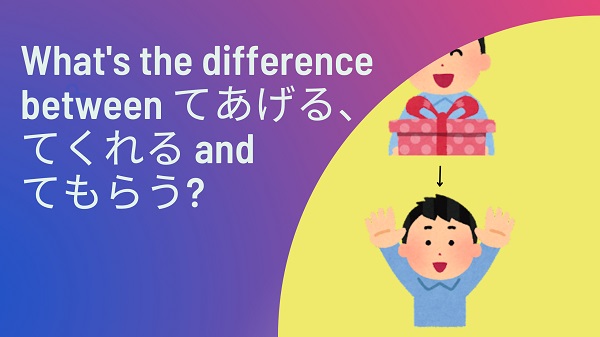
Read MoreHow do you explain when you do something for someone or someone does something for you? In this article, I will teach you how to use, as well as the differences between てあげる、てくれる and てもらう. If you have not read the article about あげる、くれる、もらう yet, please read this article first. What’s the difference between あげる、くれる…
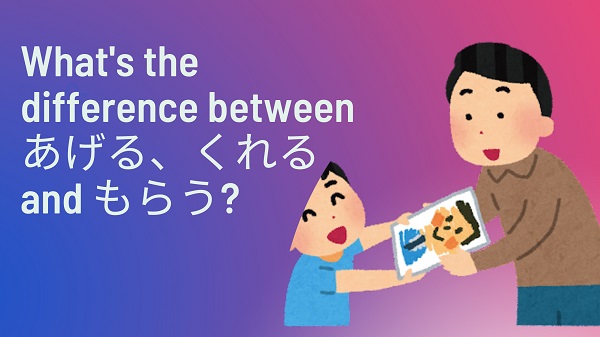
Read MoreI gave a present to my brother. My brother gave me a present. Like in these sentences, “give” is give. It won’t change whoever gives presents or receives the presents. However, there are two words for “giving”, which are あげる and くれる. What’s the difference between あげる and くれる? To understand the difference, we must…
Read MoreI love read a book. Is it correct? As you already know, this sentence is wrong because we shouldn’t include two verbs in one sentence. How about “Read a book is fun”? This isn’t correct as well because a verb can’t be the subject. Therefore, we should change “read” to “reading” or “to read”. Similarly,…
Read MoreWhen you go to Japan, how would you order food from the menu? In this article, I’m going to teach you how to order food in a Japanese restaurant. Let’s prepare for your travel! What can you learn in this article ・What do you say when you enter a restaurant? ・How do you order food?…
Read MoreHow can you ask Japanese people? In this article, I’m going to teach you the 5 Ws: What, Who, When, Where, Why. Contents WhatWhoWhenWhereWhyどうしてなんでなぜconclusionWhat When we ask “what”, we use “なに”. Let’s take a closer look at an example. Japanese:きょうは なにを しましたか。 English:What did you do today? In this case, you want to ask objective, so we…
Read MoreHow can we say “this”, “that”, “here” or “there” in Japanese? When we talk about these things, the words we use change depending on physical distance between a speaker and listener. The words are called こそあどことば because the first syllable is こ(ko), そ(so), あ(a) or ど(do). Let’s learn Japanese kosoado words in this article. What…
Read More